Market News
Stay updated with the latest market trends, earnings, and economic indicators.
INR depreciates further to one-week low as oil stays elevated amid Middle East turmoil
The Indian rupee depreciated further in opening trades on Wednesday as oil prices stay elevated, driving fears of inflationary pressures in future. INR opened at Rs 95.43 per dollar and hit a low of 95.65 so far during the day. Yesterday, rupee fell 15 paise to close at 95.34 against the US dollar, as global crude oil prices jumped and the American currency remained firm amid massive safe-haven inflows. Significant foreign fund outflows also weighed on the investor sentiments. Local equities continue to stay strained in early trades with BSE Sensex trading at 73,866.45, down by 783.39 points and NSE Nifty 50 trading at 23,247.90, down by 235.65 points.
INR settles lower as global crude oil prices stay elevated amid Middle East turmoil
The Indian rupee depreciated 15 paise to close at 95.34 (provisional) against the US dollar on Tuesday, as global crude oil prices jumped and the American currency remained firm amid massive safe-haven inflows. Significant foreign fund outflows also weighed on the investor sentiments. At the interbank foreign exchange market, the rupee opened at 95.16 against the US dollar, then touched an intraday high of 95.03 and a low of 95.37. Indian shares closed higher on Tuesday, staging a rebound after four days of losses as investors assessed mixed signals over the status of U.S.-Iran peace talks and awaited upcoming RBI rate decision. The Nifty 50 gained 100.95 points (0.43%) to close at 23,483.55, while the Sensex rose 382.50 points (0.52%) to settle at 74,649.84.
Stock markets decline for 2nd day on selling in oil, gas, banking shares
Stock markets closed lower for the second consecutive day on Wednesday as investors remained cautious amid conflicting geopolitical signals from the West Asia and fresh foreign fund outflows. In a volatile trade, the 30-share BSE Sensex declined 141.90 points, or 0.19 per cent, to settle at 75,867.80, with 20 of its constituents ending higher and 10 with losses. During the day, it hit a high of 76,224.68 and a low of 75,748.21, gyrating 476.47 points. The 50-share NSE Nifty skidded 6.55 points, or 0.03 per cent, to end at 23,907.15. Sensex had dropped by 479.26 points and Nifty by 118 points on Tuesday. Financials, oil & gas, IT and private banking shares were the major drag while energy, metals, and auto shares advanced, capping the downside. Among 30 Sensex firms, HDFC Bank fell the most by 2.63 per cent. Infosys, ITC, Hindustan Unilever, Reliance Industries and ICICI Bank were also among the major laggards. Power Grid, Eternal, NTPC and Tata Steel were the major ...
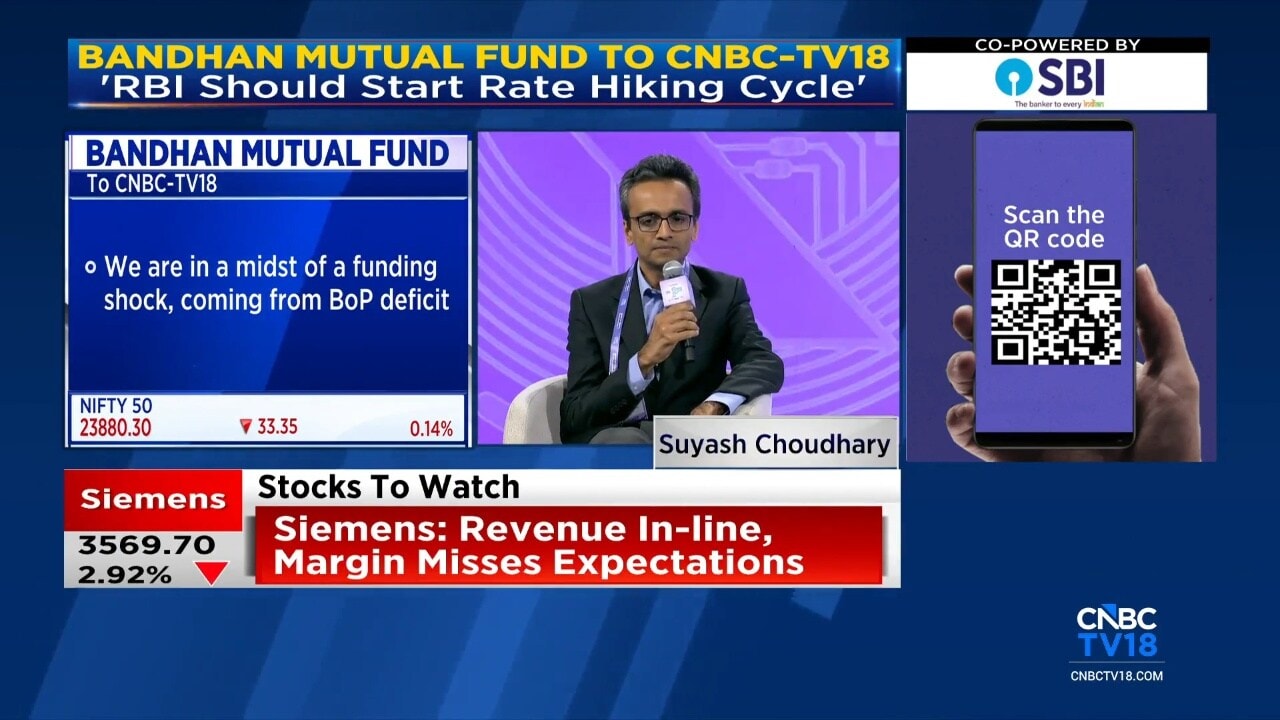
RBI should start rate hike cycle as inflation risks rise, says Bandhan MF’s Suyash Choudhary
Average inflation forecasts are likely to move higher, and the RBI should begin the rate hike cycle to maintain its credibility as an inflation-focused central bank, according to Suyash Choudhary, CIO-Fixed Income at Bandhan Mutual Fund. However, he believes rate hikes alone may not immediately solve the problem. He said the RBI must avoid mixed messaging to prevent market uncertainty and added that a favourable mix of global factors — including lower oil prices, better foreign inflows, and a weaker dollar — could help improve the situation.
INR rebounds well from historic lows as oil retreats from elevated levels; geopolitical risk and oil price sensitivity to cap upside
The Indian rupee rebounded 49 paise from its all-time closing low to settle at 96.37 against the US dollar on Thursday after crude oil prices retreated from elevated levels amid signs of easing geopolitical friction, alongside likely central bank intervention. Rupee had gained after the recent geopolitical developments, but investors are still gauging the geopolitical risk and oil price sensitivity in the background. The one-year forward market rate for the rupee touched the crucial 100/USD mark on Wednesday, indicating that currency markets are pricing in a weakening bias for the USD/INR pair over the next 12 months. Meanwhile, The Nifty 50 settled at 23,654.70 (down 4.30 points or 0.02%), while the BSE Sensex closed at 75,183.36 (down 135.03 points or 0.18%). The dollar index rose above 99.2 on Thursday, approaching again April-highs, as markets continued to track developments in the Middle East.

Retail SIP boom boosts AMC outlook; Nippon, ICICI Pru lead pack: Siddhartha Khemka
India's asset management sector is transforming with systematic investing driving growth and stability, reducing reliance on volatile discretionary capital. SIP inflows have surged, now forming a significant portion of mutual fund assets, indicating a shift towards predictable, annuity-like revenue streams. This structural change positions the industry for sustained, retail-led expansion.

KPIT Tech to Eternal - Jay Thakkar suggests 3 stocks to buy or sell for short-term in F&O segment
The Indian stock market is set for a muted start, with GIFT Nifty trading at 23,431. The Sensex and Nifty 50 have declined for four consecutive sessions, driven by rising crude oil prices and foreign fund outflows, indicating a negative short-term trend.
Nifty trades below 23,600 level as intense selling continues on domestic bourses
The domestic equity barometers extended losses in early afternoon trade as rupee weakness, sustained foreign fund outflows, elevated crude oil prices, and renewed concerns over the fragile U.S.-Iran ceasefire weighed on investor sentiment. The Nifty continued to trade below the 23,600 level. Oil & gas shares witnessed some bit of value buying at lower levels.

Equity MFs inflow dips 5% in April; SIP contributions fall to ₹31,115 cr
Equity-oriented mutual fund schemes garnered a net inflow of Rs 38,440 crore in April, marking a 5 per cent decline from the preceding month, amid geopolitical tensions in the Middle East, fluctuating crude oil prices, and concerns about global growth. Moreover, monthly contributions through SIPs (Systematic Investment Plans) declined to Rs 31,115 crore last month from Rs 32,087 crore in March,according to data released by industry body Amfi on Monday. Overall, the industry recorded a net infusion of Rs 3.22 lakh crore in April after witnessing an outflow of Rs 2.4 lakh crore in March. This was contributed by a huge inflow of Rs 2.5 lakh crore in the debt funds. The inflow has lifted the industry's assets under management by 11 per cent to Rs 81.92 lakh crore at the end of April, up from Rs 73.73 lakh crore at the end of March. This was driven by strong positive flows across segments and market to market gains witnessed during the month, said Venkat Chalasani, Chief Executive at ...

Baroda BNP Paribas MF sees easing crude boosting rate-sensitive stocks, chemicals
Baroda BNP Paribas Mutual Fund Senior Fund Manager Jitendra Sriram said softer crude prices could improve sentiment for India and support interest rate-sensitive sectors. He believes refining, oil marketing and select specialty chemical companies may benefit if West Asia tensions ease. Sriram also cautioned that higher raw material and logistics costs may pressure corporate earnings over the next few quarters despite resilient recent results. Disclaimer: The views and investment tips expressed by investment experts on CNBCTV18.com are their own and not that of the website or its management. CNBCTV18.com advises users to check with certified experts before taking any investment decisions.

US Stock Market: US equity fund inflows hit six-week low amid oil price surge and rate uncertainty - India IPO
US Stock Market: US equity fund inflows hit six-week low amid oil price surge and rate uncertaintyIndia IPO

Nifty 50 slips below 24,000: What are the key levels to watch for next week?
On April 30, Indian stock indices fell nearly 1% due to rising crude oil prices and foreign fund exits. The Nifty 50 and Sensex closed at 23,997.55 and 76,913.50, respectively. Despite this, both indices showed weekly gains, breaking previous losing streaks.