Market News
Stay updated with the latest market trends, earnings, and economic indicators.
Rupee edges lower against dollar amid oil price concerns, FPI outflows
Indian rupee opens weaker at 95.06 against US dollar as high crude prices and foreign fund outflows weigh on sentiment, RBI steps in to curb volatility.

Motilal Oswal sector of the week: AMC; here's why ICICI AMC is top pick
ICICI Prudential AMC remains well-positioned to benefit from rising retail participation, strong SIP traction and expanding market share across equity, hybrid and passive segments.
INR slides further as renewed geopolitical tensions led to surge in crude oil prices
The Indian rupee depreciated 5 paise to close at 94.90 (provisional) against the US dollar on Monday, amid renewed geopolitical tensions between the US and Iran and surge in crude oil prices. Strength of the American currency in the overseas market and Israel-Lebanon tensions also deteriorated global risk sentiments. At the interbank foreign exchange market, the rupee opened at 94.93 against the US dollar, then touched an intraday high of 94.73 and a low of 95.03 during the day. Meanwhile, domestic markets also closed sharply lower due to escalating Middle East tensions, surging crude oil prices, and ongoing foreign institutional investor (FII) outflows. The BSE Sensex settled at 74,267.34, down by 508.40 points (0.68%), and the NSE Nifty 50 ended at 23,382.60, dropping 165.15 points (0.70%).

PB Fintech sees Rs 665 crore block deal as founders pare stake; Goldman among other top funds buy
PB Fintech founders Yashish Dahiya and Alok Bansal sold 38 lakh shares worth Rs 665 crore in a block deal. The shares were purchased by various institutional investors, including Goldman Sachs and Tata Mutual Fund, following the company's recent performance.
INR settles on flat note amid renewed tensions between the US and Iran
The Indian rupee settled on a flat note, higher by 2 paise at 95.68 (provisional) against the US dollar on Wednesday, as renewed tensions between the US and Iran and delays in negotiations kept investors cautious. Meanwhile, an uptick in American currency and weak domestic markets also pressured the rupee. Attention has shifted toward the upcoming RBI Monetary Policy Committee meeting scheduled between June 3 and 5. At the interbank foreign exchange market, the rupee opened at 95.60 against the US dollar, and touched an intra-day low of 95.79 against the American currency. The BSE Sensex settled 141.90 points (0.19%) lower at 75,867.80, while the NSE Nifty 50 marginally dipped 6.55 points (0.03%) to close at 23,907.15.
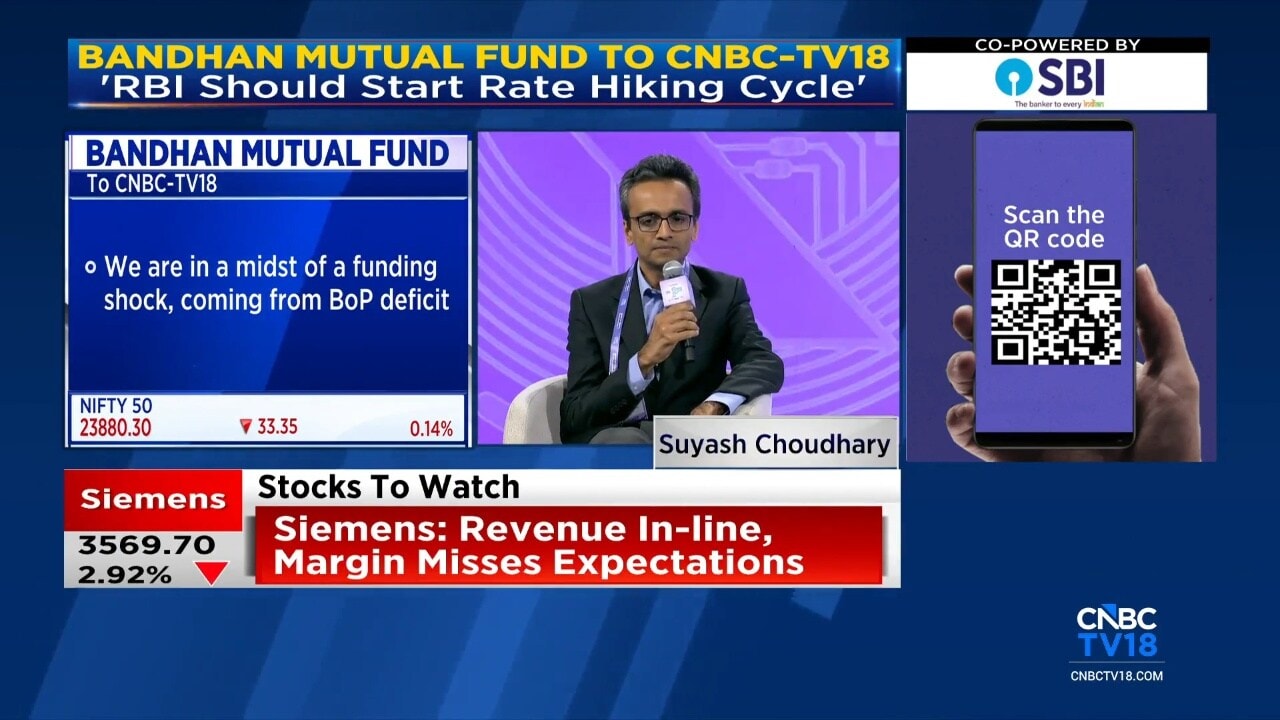
RBI should start rate hike cycle as inflation risks rise, says Bandhan MF’s Suyash Choudhary
Average inflation forecasts are likely to move higher, and the RBI should begin the rate hike cycle to maintain its credibility as an inflation-focused central bank, according to Suyash Choudhary, CIO-Fixed Income at Bandhan Mutual Fund. However, he believes rate hikes alone may not immediately solve the problem. He said the RBI must avoid mixed messaging to prevent market uncertainty and added that a favourable mix of global factors — including lower oil prices, better foreign inflows, and a weaker dollar — could help improve the situation.
INR rebounds well from historic lows as oil retreats from elevated levels; geopolitical risk and oil price sensitivity to cap upside
The Indian rupee rebounded 49 paise from its all-time closing low to settle at 96.37 against the US dollar on Thursday after crude oil prices retreated from elevated levels amid signs of easing geopolitical friction, alongside likely central bank intervention. Rupee had gained after the recent geopolitical developments, but investors are still gauging the geopolitical risk and oil price sensitivity in the background. The one-year forward market rate for the rupee touched the crucial 100/USD mark on Wednesday, indicating that currency markets are pricing in a weakening bias for the USD/INR pair over the next 12 months. Meanwhile, The Nifty 50 settled at 23,654.70 (down 4.30 points or 0.02%), while the BSE Sensex closed at 75,183.36 (down 135.03 points or 0.18%). The dollar index rose above 99.2 on Thursday, approaching again April-highs, as markets continued to track developments in the Middle East.

Expert View | Retail investors should prioritise portfolio resilience over aggression: Siddhartha Khemka, Motilal Oswal - Mint
Expert View | Retail investors should prioritise portfolio resilience over aggression: Siddhartha Khemka, Motilal OswalMint
INR edges closer to a critical 97/$ threshold
The Indian rupee is seen in deep distress as the counter is moving towards breaking yet another key historic mark in opening trades on Wednesday. INR opened at Rs 96.89 per dollar and hit a low of 96.95 so far during the day. Yesterday, rupee slipped to a record low of 96.60 against the US dollar before settling at 96.52, weighed down by soaring crude oil prices, persistent foreign capital outflows, and a resilient dollar buoyed by global risk-aversion. The rupee is turning to be Asia's worst-performing currency in 2026. The currency has depreciated 1.5 per cent this month and more than 7 per cent so far this year. Rupee remains vulnerable to rising crude oil prices and the closure of the Strait of Hormuz. Meanwhile, the Indian equity benchmarks surrendered their early morning gains in a highly volatile trading session to settle marginally lower due to late profit-booking. The BSE Sensex declined 114.19 points (0.15%) to close at 75,200.85, while the NSE Nifty 50 slipped 31.95 points
INR collapses to new historic lows driven by global conflicts and energy spikes
The Indian rupee slipped to a record low of 96.60 against the US dollar before settling at 96.52 (provisional) on Tuesday, weighed down by soaring crude oil prices, persistent foreign capital outflows, and a resilient dollar buoyed by global risk-aversion. The rupee is Asia's worst-performing currency in 2026, having tumbled to a historic intraday low of 96.60 against the US dollar. The currency has depreciated 1.5 per cent this month and more than 7 per cent so far this year. Rupee remains vulnerable to rising crude oil prices and the closure of the Strait of Hormuz. Meanwhile, the Indian equity benchmarks surrendered their early morning gains in a highly volatile trading session to settle marginally lower due to late profit-booking. The BSE Sensex declined 114.19 points (0.15%) to close at 75,200.85, while the NSE Nifty 50 slipped 31.95 points (0.14%) to finish at 23,618.00.

Retail SIP boom boosts AMC outlook; Nippon, ICICI Pru lead pack: Siddhartha Khemka
India's asset management sector is transforming with systematic investing driving growth and stability, reducing reliance on volatile discretionary capital. SIP inflows have surged, now forming a significant portion of mutual fund assets, indicating a shift towards predictable, annuity-like revenue streams. This structural change positions the industry for sustained, retail-led expansion.
INR slumps to fresh record lows amid rising oil prices fuelled by ongoing geopolitical tensions
The Indian rupee weakened further and closed at a record low of 96.35 (provisional) against the US dollar on Monday, pressured by rising crude oil prices on the back of ongoing geopolitical tensions and a strong dollar. During the day, the counter hit a low of 96.39. The global market sentiments continue to dampen amid simmering tensions between the US and Iran. Moreover, emerging market economies, including India, continue to feel the pressure of rising crude oil prices, as elevated rates increase the outflows of US dollars, along with the outflows already happening due to FPIs. Meanwhile, Indian shares ended little changed on Monday, after having suffered heavy losses earlier in the session on rising Middle East tensions and economic concerns. The benchmark BSE Sensex rebounded over 1,100 points from the day's lows before closing 77.05 points, or 0.10 percent, higher at 75,315.04.The NSE Nifty index also fell up to 1.3 percent in early trading before recovering to close up 6.45 ...