Market News
Stay updated with the latest market trends, earnings, and economic indicators.
INR collapses to new historic lows driven by global conflicts and energy spikes
The Indian rupee slipped to a record low of 96.60 against the US dollar before settling at 96.52 (provisional) on Tuesday, weighed down by soaring crude oil prices, persistent foreign capital outflows, and a resilient dollar buoyed by global risk-aversion. The rupee is Asia's worst-performing currency in 2026, having tumbled to a historic intraday low of 96.60 against the US dollar. The currency has depreciated 1.5 per cent this month and more than 7 per cent so far this year. Rupee remains vulnerable to rising crude oil prices and the closure of the Strait of Hormuz. Meanwhile, the Indian equity benchmarks surrendered their early morning gains in a highly volatile trading session to settle marginally lower due to late profit-booking. The BSE Sensex declined 114.19 points (0.15%) to close at 75,200.85, while the NSE Nifty 50 slipped 31.95 points (0.14%) to finish at 23,618.00.
How JSW Energies’ Rs 3,150-crore JSW Steel stake sale will help lower debt, Jefferies explains
JSW Energy’s Rs 3,150-crore stake sale in JSW Steel to GQG Partners and SBI Mutual Fund is expected to strengthen its balance sheet. Jefferies says the move will lower leverage, support capex plans and improve execution visibility, prompting a target price upgrade to Rs 675.
Block deal: JSW Energy sells Rs 3,150 crore JSW Steel stake to GQG, SBI Mutual Fund
JSW Energy has divested a portion of its JSW Steel stake for Rs 3,150 crore to fund its aggressive power generation expansion. The company aims to reach 30 GW capacity by 2030, bolstered by both renewable and thermal power projects. This strategic move enhances capital allocation and supports long-term growth initiatives.
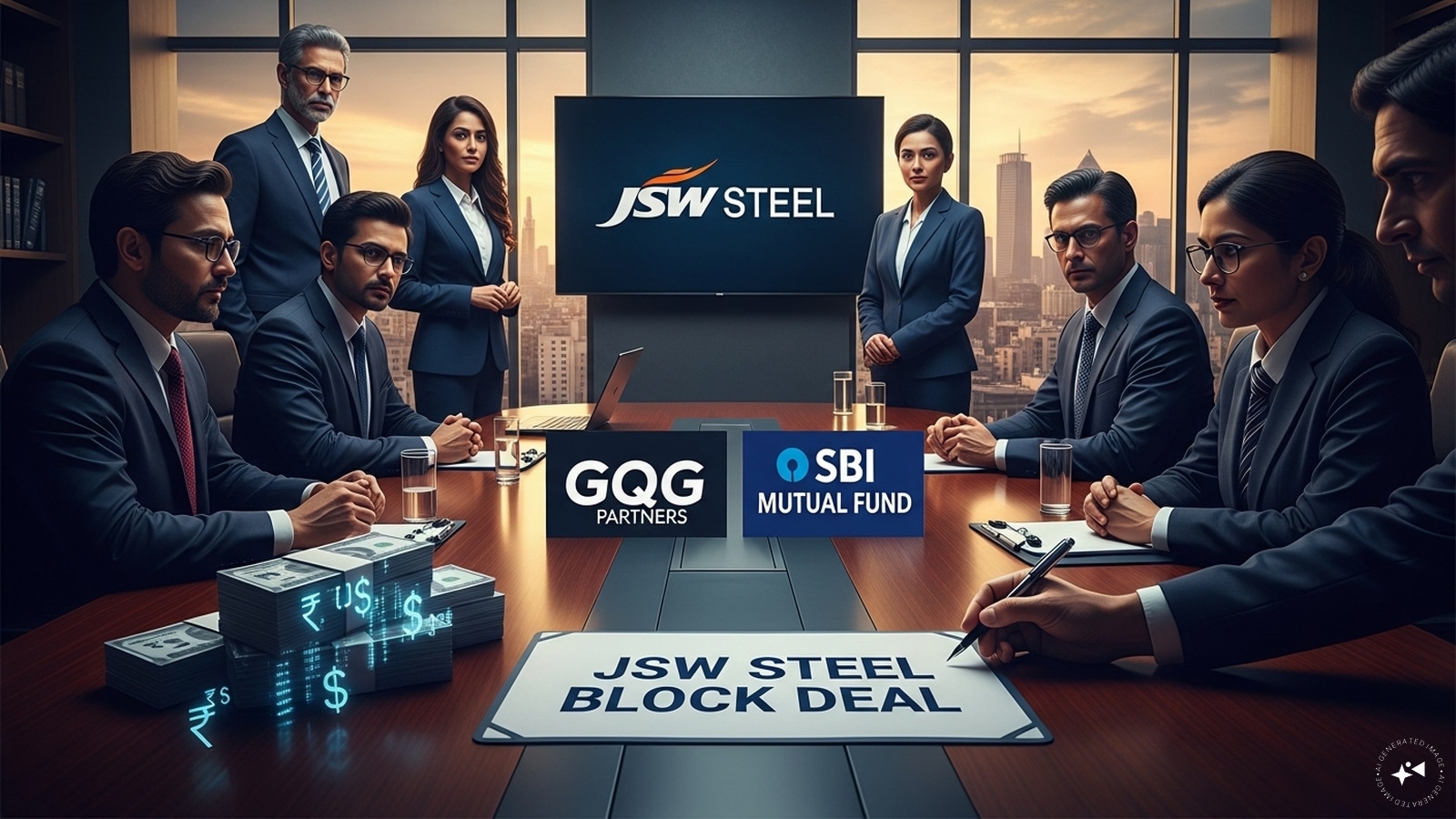
JSW Steel block deal sees GQG, SBI MF as key buyers
GQG Partners and SBI Mutual Fund emerged as key buyers in a block deal of JSW Steel on May 18, reflecting in the day’s institutional inflow data. The transaction, valued at around ₹3,150 crore, saw JSW Energy offload 2.5 crore shares at ₹1,260 apiece. GQG acquired 1.5 crore shares, while SBI Mutual Fund picked up 1 crore shares, indicating strong institutional appetite for the steel major.

Nifty to hit 42,000 by 2028? New paper that studied market cycles says it's possible if these factors align
A CNI InfoXchange study projects the Nifty could surpass 42,000 by 2028 if sustained foreign investor inflows return. The report highlights stronger domestic liquidity, resilient equity markets, robust GDP growth prospects, rising retail participation, and India’s increasing weight in global emerging market indices.

Deepak Shenoy backs capital gain tax relief for FPIs in Indian bond markets, explains why it makes investing difficult
Deepak Shenoy emphasizes the need to reform tax policies for foreign institutional investors in India. He argues that current capital gains taxes create challenges for foreign investment and suggests making gains tax-free to enhance the attractiveness of Indian debt markets.

Dalal Street set for negative opening as GIFT Nifty trades lower
Nifty closed at 23,690 on Thursday. IT shares faced pressure from global AI competition. Markets will watch West Asia conflict, energy prices, and foreign fund flows. A move above 23,800 could boost Nifty higher. Failure to hold this level may bring selling pressure. India VIX fell. SAIL and Kaynes are in F&O ban. Foreign investors bought shares.
INR settles around record low level as energy crisis deepen
The Indian rupee weakened further and fell to a record low of 95.73 (provisional) against the US dollar on Thursday, amid a strong dollar and worries over inflation amid elevated energy prices. International oil prices continued to hold around $100 per barrel mark that kept rupee under pressure. The rupee is expected to trade with a negative bias amid inflation concerns and the strength of the US dollar in the overseas market. The West Asia crisis and the blockade of the Strait of Hormuz have disrupted crude petroleum imports into India. Investors also awaited the outcome of U.S. President Donald Trump's summit with Chinese President Xi Jinping in Beijing. However, positive local equities limited losses in the domestic unit to some extent. Indian equity markets settled sharply higher for the second consecutive session, with the Sensex rising 789.74 points (1.06%) to 75,398.72 and the Nifty gaining 277 points (1.18%) to 23,689.60.

‘Time for alpha’: Motilal Oswal AMC CEO sees these sectors leading next market cycle
Motilal Oswal AMC MD & CEO Prateek Agrawal said the current market environment favours active investing and emerging growth sectors over traditional index-heavy plays. Agrawal also said gold duty hikes were less severe than expected and added that mutual fund inflows remain stable despite market volatility.

Dalal Street set for firm start as GIFT Nifty edges higher
Indian markets extended losses for the fourth consecutive session amid escalating US-Iran tensions and global market nervousness. Investors remained risk-averse, leading to sustained selling. Market sentiment is expected to stay fragile until geopolitical clarity emerges and energy prices stabilize.

Stocks in news: Groww, Dr Reddy's, Waaree Energies, Lenskart, SBI
Markets experienced a sharp risk-off session on Monday, with indices declining amid broad selling. Investors are advised to avoid aggressive index bets and await clearer directional signals. Pharma and healthcare stocks remain preferred, while dips in energy and metal sectors offer accumulation opportunities.

Sebi proposes 'GARUDA' mechanism to speed up AIF scheme launches
Markets regulator Sebi on Monday proposed a new green-channel mechanism -- GARUDA-- for alternative investment funds (AIFs) to launch schemes to 10 working days of filing their placement memorandums from the current 30 days, in a bid to speed up the deployment of capital by them. GARUDA, or Green-Channel: AIF Rollout Upon Document Acknowledgement, aims to streamline the Processing of Placement Memorandums (PPMs) filed with Sebi and further ease fundraising by AIFs. Under the proposal, regular AIF schemes would be allowed to launch within 10 working days of filing the PPM with Sebi through a merchant banker, unless the regulator raises objections. At present, AIFs can launch schemes only after 30 days from filing, Sebi said in its consultation paper. For the first scheme of an AIF, launch would be permitted from the date of grant of registration or after 10 working days of filing the application, whichever is later. Sebi said the move would "further enable faster and efficient ...