Market News
Stay updated with the latest market trends, earnings, and economic indicators.

NLC India OFS opens for retail today after strong non-retail response - All you need to know
The government has decided to exercise the entire greenshoe option in the NLC India OFS, after the non-retail portion was oversubscribed 5.22 times, taking the total offer size to 3% of the company's equity capital from the initially planned 2%.

NLC India OFS: Government exercises greenshoe option
The total offer size has now increased to 3% of equity capital from 2%; retail investors will get 10% of the expanded issue on June 10. NLC India shares settled 2.13% lower at ₹328.60 on the NSE on June 9, before the announcement.
RBI introduces US dollar-rupee forex swap facility for fresh FCNR deposits
The Reserve Bank introduced a US dollar-rupee forex swap facility for fresh FCNR (B) deposits mobilised by banks for a minimum tenor of three years and a maximum of five years to attract foreign capital. Foreign Currency Non-Resident (Bank) deposits are foreign currency term deposits maintained by non-resident Indians (NRIs). The swap facility will be available to the AD Category I banks for fresh FCNR(B) deposits mobilized in any freely convertible currency, including deposits that are renewed upon maturity, for a minimum tenor of three years and maximum tenor of five years. However, the swap facility with RBI will be available in US Dollars only, RBI stated. Under the swap arrangement, a bank can sell US Dollars in multiples of USD one million to the RBI and simultaneously agree to buy the same amount of US dollars at the end of the swap period, the central bank circular said.
INR losses momentum as dollar index spikes above 100 mark
The Indian rupee slipped in opening trades on Monday tracking sharp spike in dollar index above 100 mark. Dollar index spiked above 100 for the first time in two months following a strong jobs data, driving sooner than expected rate hike by Fed. INR opened at Rs 95.35 per dollar and hit a high of 95.28 so far during the day. On Friday, rupee ended at 95.18. Indian shares are seen opening sharply lower on Monday as investors weigh weak global cues and escalating Middle East tension against strong domestic GDP data as well as the Indian government's decision eliminating the 12.5 percent long term capital gains tax on foreign institutional investment in government bonds. India's economy grew an unexpectedly strong 7.8% year-on-year in the January-March quarter, the government said on Friday, as robust private investment, farm output and construction activity offset the early impact of the Middle East conflict.

Rupee opens 37 paise lower at 95.32 against US dollar
The Indian rupee fell to 95.32 against the US dollar due to geopolitical tensions, rising oil prices, and a global selloff. RBI measures may attract $30-50 billion in capital inflows, improving outlook, though the currency remains sensitive to oil price movements.
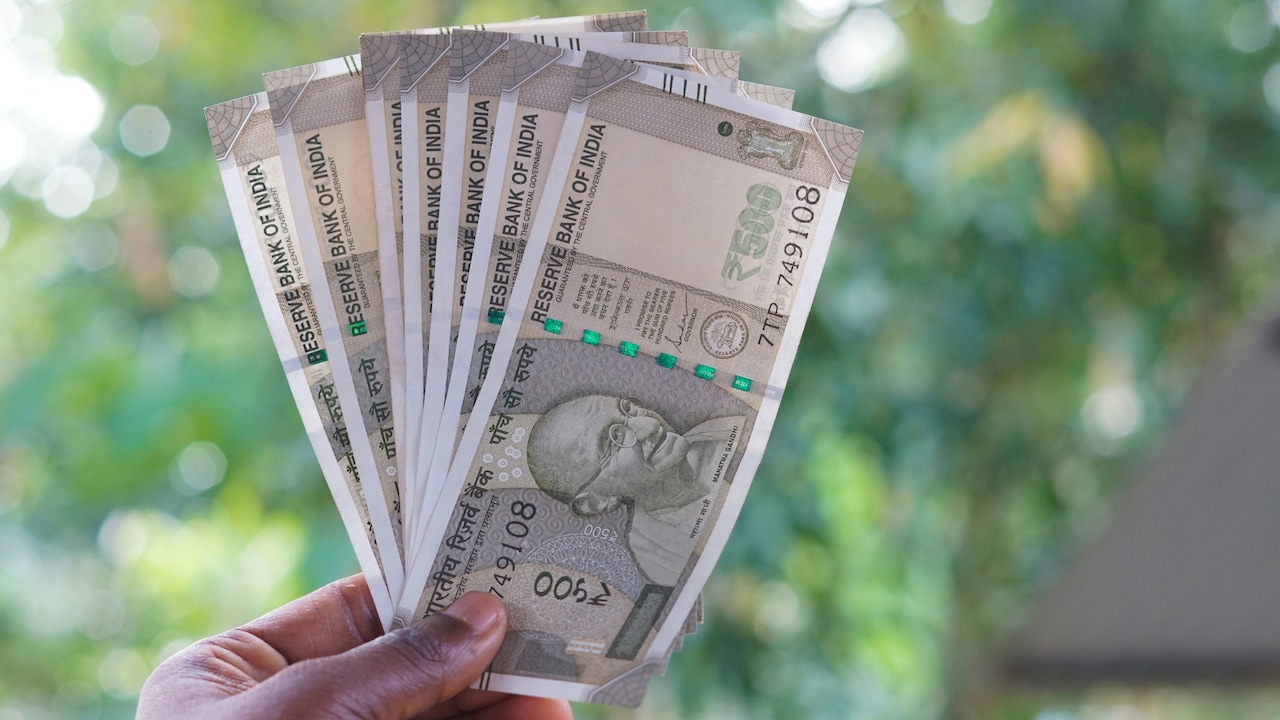
Rupee May Recover Up To 92/Dollar On Fresh Capital Inflows After RBI's G-Secs Move
Rupee's imminent rebound on the horizon for experts
INR appreciates under Rs 95 per dollar after RBI announces measures to support foreign capital inflows and strengthen forex liquidity
The Indian rupee appreciated 81 paise to close at 94.93 (provisional) against the US dollar on Friday after the Reserve Bank announced measures to support foreign capital inflows and strengthen forex liquidity. The announcements in the RBI policy boosted investor sentiments after the apex bank asserted that the country's forex reserves provide a sufficient buffer against external shocks. The Reserve Bank on Friday expectedly kept interest rates unchanged for the second time in a row as it weighed the impact of rising energy prices and supply disruptions caused by the West Asia crisis. The RBI kept its repo rate Steady at 5.25% amid uncertainty owing to US-Iran War. However, it expanded the Fully Accessible Route, or FAR, to include all new 15-year, 30-year and 40-year government security issuances. Due to this, the foreign investors will get wider access to longer-tenor Indian government bonds. This also opens up more room to invest in Indias bond market. The central bank has also ...
Govt exempts foreign investments in G-secs from capital gains tax
In a bid to attract dollar inflow, the government has scrapped long-term capital gains tax on investments made by foreign institutional investors (FIIs) in government securities through an Ordinance issued on Friday. The Ordinance has brought changes in the Income Tax Act to provide the exemption. The government has decided to remove the capital gains tax on G-secs to attract long-term, patient capital because these instruments have a longer tenure.

India growth story intact, AI not a bubble yet, Citi’s Aloke Gupte says
Rupee depreciation is a big factor people consider, because anyone running a global portfolio looks at returns on a dollar basis, not on an individual currency basis, and the rupee's performance impacts what you have invested, Aloke Gupte, Citigroup's co-head of global equity capital markets, said.
INR continues to stay pressured near record lows
The Indian rupee continues to stay pressured near record low levels in opening trades on Thursday, as strong dollar demand, surging crude oil prices, geopolitical tensions, and relentless foreign capital outflows dented investor sentiments. Meanwhile, the US Trade Representative proposed a 12.5 per cent additional duties on Indian imports, citing labour violations, further weighing on the counter. INR opened at Rs 95.70 per dollar and hit a low of 95.75 so far during the day, yesterday, the pair settled lower at 95.72. Muted local equities also failed to support the local unit. The BSE Sensex is trading at 74,191.65 (down 0.21%) and the NSE Nifty 50 stands at 23,322.60 (down 0.35%), extending losses due to escalating conflicts in West Asia, surging Brent crude oil prices and sustained foreign portfolio investor (FPI) selling.
Growing geo-political tensions dampen rupee sentiments; US proposes fresh tariff on India
The Indian rupee depreciated 35 paise to close at 95.72 (provisional) against the US dollar on Wednesday, after the US Trade Representative proposed a 12.5 per cent additional duties on Indian imports, citing labour violations. Besides, a strong dollar demand, surging crude oil prices, geopolitical tensions, and relentless foreign capital outflows dented investor sentiment further. At the interbank foreign exchange market, the rupee opened at 95.43 against the US dollar, then touched an intraday low of 95.80 and finally ended the session at 95.72 (provisional), down 35 paise from its previous close. The Indian equity benchmarks closed lower after a volatile session, with the BSE Sensex falling 303.67 points (0.41%) to settle at 74,346.17 and the NSE Nifty 50 dropping 77.95 points (0.33%) to end at 23,405.60.

Which sectors are expensive & which are cheap? PL Capital's valuation guide
PL Capital says defence, power and capital goods stocks remain richly valued, while IT, retail, hotels and real estate trade below historical averages