Market News
Stay updated with the latest market trends, earnings, and economic indicators.
INR extends slump beyond Rs 95 per dollar mark
The Indian rupee extended slump beyond Rs 95 per dollar mark on Tuesday as oil prices shot up late yesterday amid stalled talks between US and Iran reigniting fears of oil supply disruption. Crude oil prices surged following reports from Iran's news agency indicating that Tehran has halted indirect negotiations with the United States. INR opened at Rs 95.16 per dollar and hit a low of 95.18 so far during the day. Yesterday, the counter settled at 95.19. Meanwhile, the Indian stock market is extending its losses today, tracking weak global cues and Middle East tensions. The BSE Sensex dropped by over 440 points in early trade, slipping into the 74,200 range, while the NSE Nifty 50 fell beneath the 23,250 mark.
INR slides further as renewed geopolitical tensions led to surge in crude oil prices
The Indian rupee depreciated 5 paise to close at 94.90 (provisional) against the US dollar on Monday, amid renewed geopolitical tensions between the US and Iran and surge in crude oil prices. Strength of the American currency in the overseas market and Israel-Lebanon tensions also deteriorated global risk sentiments. At the interbank foreign exchange market, the rupee opened at 94.93 against the US dollar, then touched an intraday high of 94.73 and a low of 95.03 during the day. Meanwhile, domestic markets also closed sharply lower due to escalating Middle East tensions, surging crude oil prices, and ongoing foreign institutional investor (FII) outflows. The BSE Sensex settled at 74,267.34, down by 508.40 points (0.68%), and the NSE Nifty 50 ended at 23,382.60, dropping 165.15 points (0.70%).

Muted opening likely as GIFT Nifty hints at a cautious start for D-Street
Indian markets experienced a significant downturn on Friday, with the Nifty closing 1.5% lower due to broad-based profit booking and increased volatility from MSCI index rebalancing. Analysts anticipate range-bound movement next week, though mid and small-cap stocks may continue to outperform. Global sentiment saw some relief from a potential US-Iran ceasefire.
Stock markets decline for 2nd day on selling in oil, gas, banking shares
Stock markets closed lower for the second consecutive day on Wednesday as investors remained cautious amid conflicting geopolitical signals from the West Asia and fresh foreign fund outflows. In a volatile trade, the 30-share BSE Sensex declined 141.90 points, or 0.19 per cent, to settle at 75,867.80, with 20 of its constituents ending higher and 10 with losses. During the day, it hit a high of 76,224.68 and a low of 75,748.21, gyrating 476.47 points. The 50-share NSE Nifty skidded 6.55 points, or 0.03 per cent, to end at 23,907.15. Sensex had dropped by 479.26 points and Nifty by 118 points on Tuesday. Financials, oil & gas, IT and private banking shares were the major drag while energy, metals, and auto shares advanced, capping the downside. Among 30 Sensex firms, HDFC Bank fell the most by 2.63 per cent. Infosys, ITC, Hindustan Unilever, Reliance Industries and ICICI Bank were also among the major laggards. Power Grid, Eternal, NTPC and Tata Steel were the major ...

Monetise idle household gold, ease compliance burden to build Viksit Bharat: Kotak MF's Nilesh Shah
Nilesh Shah of Kotak Mutual Fund suggests India must unlock its vast household gold reserves. He also calls for easing business regulations. These steps are crucial for India's development. He highlighted significant gold imports and the potential of gold financing. Entrepreneurs are driving innovation despite challenges. Support for businesses is vital for global competition.
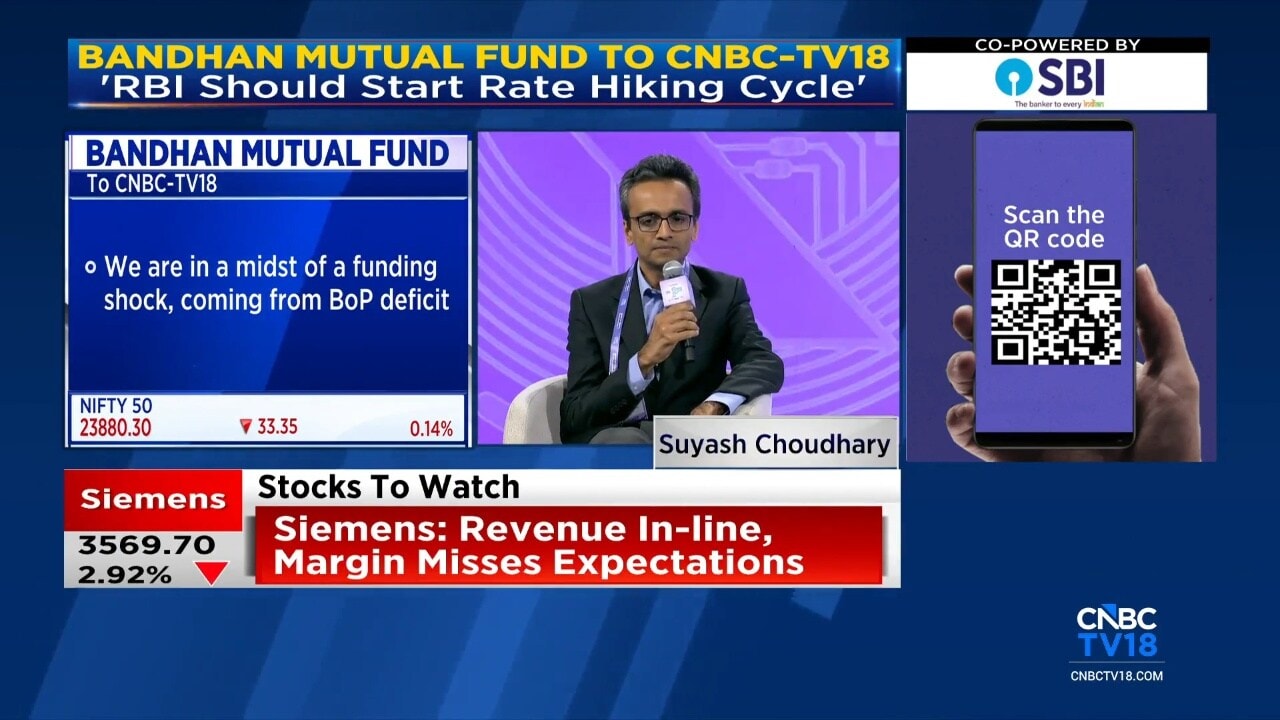
RBI should start rate hike cycle as inflation risks rise, says Bandhan MF’s Suyash Choudhary
Average inflation forecasts are likely to move higher, and the RBI should begin the rate hike cycle to maintain its credibility as an inflation-focused central bank, according to Suyash Choudhary, CIO-Fixed Income at Bandhan Mutual Fund. However, he believes rate hikes alone may not immediately solve the problem. He said the RBI must avoid mixed messaging to prevent market uncertainty and added that a favourable mix of global factors — including lower oil prices, better foreign inflows, and a weaker dollar — could help improve the situation.

Diamonds in the dust? Retail investors unleash Rs 17,500 crore on 8 battered bluechip stocks
Retail investors pumped an estimated Rs 17,539 crore into eight battered Nifty bluechip stocks during the March 2026 quarter, betting aggressively on market leaders despite steep declines in portfolio values. HDFC Bank, ITC, Wipro, Infosys, TCS, Reliance Industries and L&T emerged as top retail picks even as their shares fell sharply.

Global cues extend to D-Street, indices climb more than 1%
Indian equities surged over 1% on Monday, with the Nifty reclaiming the 24,000 mark, driven by optimism over a potential US-Iran agreement easing tensions and oil prices falling below $100. The rupee also climbed, and bond yields slid as volatility eased, signaling improving risk expectations.

The 20 stocks mutual funds are buying with Rs 1 lakh crore to defy historic FII selling
Indian mutual funds are investing Rs 1.07 lakh crore in 20 key stocks to counter historic FII selling. They are focusing on large-cap private lenders and select IT firms, using market dips to acquire favored stocks at attractive valuations. This strategy aims to build a defensive portfolio against global volatility.
INR edges closer to a critical 97/$ threshold
The Indian rupee is seen in deep distress as the counter is moving towards breaking yet another key historic mark in opening trades on Wednesday. INR opened at Rs 96.89 per dollar and hit a low of 96.95 so far during the day. Yesterday, rupee slipped to a record low of 96.60 against the US dollar before settling at 96.52, weighed down by soaring crude oil prices, persistent foreign capital outflows, and a resilient dollar buoyed by global risk-aversion. The rupee is turning to be Asia's worst-performing currency in 2026. The currency has depreciated 1.5 per cent this month and more than 7 per cent so far this year. Rupee remains vulnerable to rising crude oil prices and the closure of the Strait of Hormuz. Meanwhile, the Indian equity benchmarks surrendered their early morning gains in a highly volatile trading session to settle marginally lower due to late profit-booking. The BSE Sensex declined 114.19 points (0.15%) to close at 75,200.85, while the NSE Nifty 50 slipped 31.95 points
INR collapses to new historic lows driven by global conflicts and energy spikes
The Indian rupee slipped to a record low of 96.60 against the US dollar before settling at 96.52 (provisional) on Tuesday, weighed down by soaring crude oil prices, persistent foreign capital outflows, and a resilient dollar buoyed by global risk-aversion. The rupee is Asia's worst-performing currency in 2026, having tumbled to a historic intraday low of 96.60 against the US dollar. The currency has depreciated 1.5 per cent this month and more than 7 per cent so far this year. Rupee remains vulnerable to rising crude oil prices and the closure of the Strait of Hormuz. Meanwhile, the Indian equity benchmarks surrendered their early morning gains in a highly volatile trading session to settle marginally lower due to late profit-booking. The BSE Sensex declined 114.19 points (0.15%) to close at 75,200.85, while the NSE Nifty 50 slipped 31.95 points (0.14%) to finish at 23,618.00.

Why Emkay is seeing Nifty at 29,000 by March 2027 despite oil shock, West Asia tensions
Emkay Global maintains a bullish outlook on Indian equities, projecting the Nifty could reach 29,000 by March 2027, driven by strong domestic growth, earnings recovery and policy support. The brokerage expects markets to navigate near-term volatility from geopolitical tensions & high crude prices. It also warns of macro risks from elevated oil but sees long-term structural growth in Indian equities intact.