Market News
Stay updated with the latest market trends, earnings, and economic indicators.
Indian stock market: 10 things that changed for market over weekend - Gift Nifty, US-Iran war, oil crises to gold rate - Mint
Indian stock market: 10 things that changed for market over weekend - Gift Nifty, US-Iran war, oil crises to gold rateMint
INR tumbles to new lifetime lows; Benchmark indices melt amid West Asia conflict and escalating oil prices
The Indian rupee slumped to close at a fresh record low of 92.37 (provisional) against the US dollar on Friday as crude oil prices crossed USD 101/barrel amid the raging West Asia conflict. A stronger greenback, heavy foreign fund outflows and sustained selling in the domestic equity markets further weighed on the rupee. At the interbank foreign exchange, the local unit opened at 92.33 and kept losing ground to hit a fresh intra-day low of 92.47 against the US dollar. It eventually settled at its lifetime low of 92.37 (provisional), down 11 paise from its previous close. Indian shares plunged on Friday to extend their recent string of losses as oil prices climbed back above $100 a barrel amid an ongoing conflict in West Asia involving Iran, Israel and the United States. The Sensex dropped by 1,470 points to close at 74,563, while the Nifty 50 fell 488 points, settling at 23,151.

$100 crude gives Rs 20 lakh crore shock to Nifty bulls this week. Best time to buy the fear?
Crude oil above $100 has wiped out Rs 20 lakh crore in equity wealth, hammering markets in India as the Iran conflict escalates. The rupee hit a record low, and FIIs continue to sell, yet experts and Axis Mutual Fund argue the panic may be creating a rare long-term buying window.
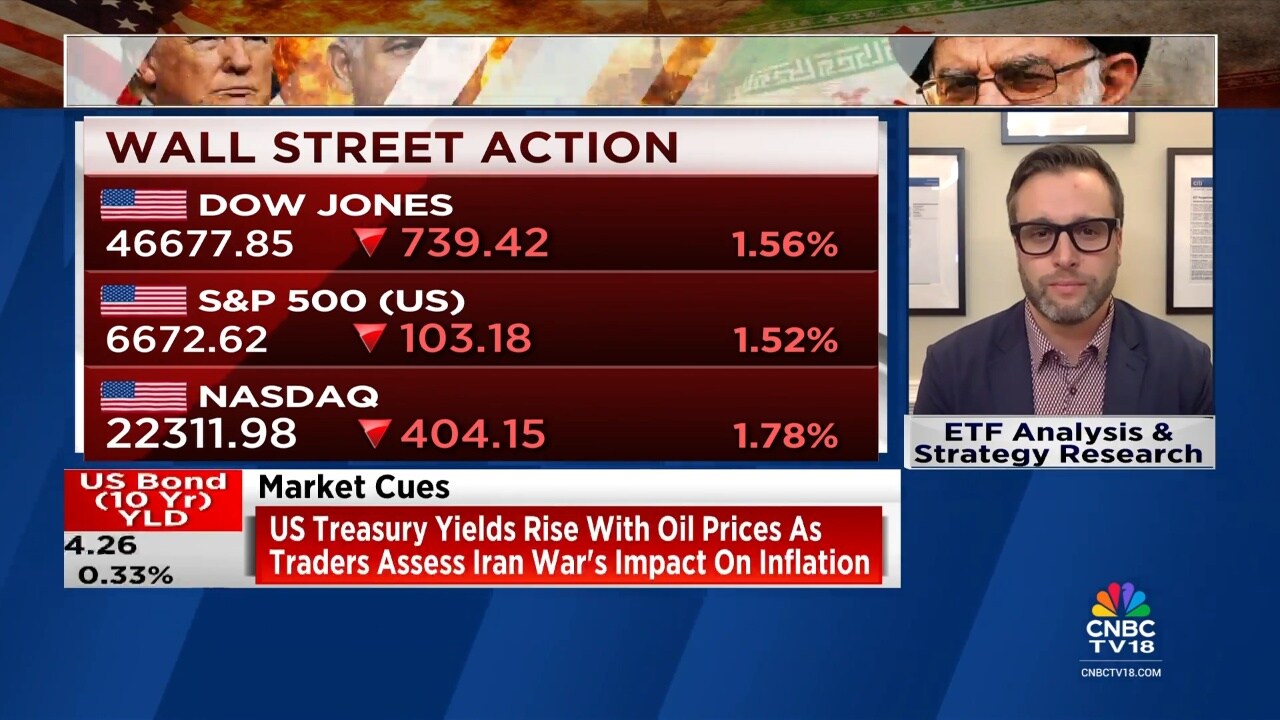
Fed may still cut rates if labour market weakens despite oil shock: Citi
Drew Pettit, Director-US Equity Strategy, ETF Analysis & Strategy Research at Citi, says the bullish case for US equities remains intact as secular growth trends continue to support earnings, with Citi’s street-high $320 EPS estimate possibly conservative. However, sustained high interest rates and elevated oil prices could challenge valuations. Citi believes the Fed may still cut rates if labour markets weaken. In a bear scenario, earnings could fall to $300. He adds India remains neutral amid valuation concerns.
INR recovers from record lows but settles beyond 92/$ mark
The Indian rupee recovered from record low levels and settled with a loss of 16 paise at 92.17 (provisional) against the US dollar on Thursday as global crude oil prices stayed on an upward trajectory amid the raging war in West Asia. A stronger greenback and volatility in the domestic equity markets further weighed on the rupee, which was already on a weak footing in early trade due to heavy foreign fund outflows. Indian shares fell sharply on Thursday to extend losses from the previous session as the prospect of a quick end to the war in West Asia thinned and trade tensions resurfaced. At close, the Sensex declined 829.29 points, or 1.08 per cent, to settle at 76,034.42, taking its two-day decline to 2,171.56 points. While the Nifty slipped 227.70 points, or 0.95 per cent, to close at 23,639.15, it slipped 2.56% in two sessions. At the interbank foreign exchange, the local unit opened at 92.25 but kept slipping to touch its record intra-day low against the greenback at 92.36. ...

US-Iran war, high crude oil prices could shave off as much as 4% from Nifty earnings: Somil Mehta, Mirae Asset Sharekhan
Expert view: Higher energy costs increase input expenses for several sectors, which could pressure margins and reduce overall earnings growth across companies in the Nifty index, said Somil Mehta, Mirae Asset Sharekhan.

Ahead of Market: 10 things that will decide stock market action on Thursday
Indian stock markets, Sensex and Nifty, experienced a significant downturn on Wednesday. Both indices closed nearly 2% lower. This decline followed a surge in crude oil prices and heightened tensions in West Asia. Foreign fund outflows and selling in major bank stocks also contributed to the market's fall. Investors are now awaiting key inflation data from the US and India.

Goldman Sachs sees Nifty at 29,300 in the next 12 months
Goldman Sachs Chief Global Strategist Peter Oppenheimer says strong earnings growth and a supportive domestic macro environment could support Indian markets although geopolitical tensions and rising oil prices may create short-term volatility. While high valuations globally might cause market corrections, he does not expect a prolonged bear market.

DSP Mutual Fund flags global shifts, expensive midcaps, IT lag: How investors may position portfolios
DSP Mutual Fund advises caution and diversification amid market risks like rising oil prices and high US equity valuations. AI spending by tech giants drives global markets.

Market Trading Guide: Apollo Pipes among 3 stock recommendations for Tuesday
Sensex and Nifty plunged nearly 2% as rising crude oil prices, weak global cues and escalating West Asia tensions triggered heavy selling. Foreign fund outflows and a weaker rupee added pressure. Analysts recommend Apollo Pipes, Aurobindo Pharma and Tata Steel for potential short-term gains.

India's coal production likely to grow 6-7% annually over next few years: Kishan Reddy
India is on the verge of a coal production boom, with forecasts suggesting an impressive surge to 1.5 billion tonnes by 2029-30. This ambitious growth plan is designed to satisfy the country's soaring energy demands. Domestic coal output is projected to grow at a rate of 6-7 percent yearly, decreasing the need for foreign coal imports.

Markets in ‘fear phase’, deploy money in autos, banks, capital goods: AlfAccurate’s Rajesh Kothari
The sharp correction in Indian equities triggered by fears of a prolonged war in West Asia should be viewed as a buying opportunity, according to Rajesh Kothari, Managing Director at AlfAccurate Advisors.Benchmark indices declined nearly 3% this week — their steepest weekly fall in over a year — as rising crude oil prices and geopolitical tensions rattled investor sentiment. Financial stocks led the decline, with the Nifty Bank logging its biggest weekly drop in 14 months.However, Kothari believes the selloff reflects sentiment rather than a deterioration in underlying economic fundamentals.“We are currently in a fearful phase of the market. When others are fearful, that’s usually the time to be greedy,” Kothari told CNBC-TV18, advising investors to deploy money gradually over the next 30–60 days rather than attempting to time the market.He emphasised that the outcome of the West Asia conflict is less important for markets than its duration. While companies with exposure to the Middle East could face short-term uncertainty, the broader domestic growth story remains intact.Against this backdrop, Kothari highlighted four sectors that investors should focus on.Autos remain a key bet, supported by strong demand trends and low inventory levels across the industry. February sales data was robust, and leading automakers have reported healthy growth, signalling sustained momentum.Banking and financials are another preferred sector. Credit growth has improved to around 13% from about 8.5% earlier, while asset quality remains strong. According to Kothari, the sector could become a “strong buy on declines” if crude-driven inflation concerns ease.He also sees opportunities in capital goods, particularly companies reporting strong order inflows as India’s investment cycle picks up.Lastly, hospitals stand out as a defensive play. The sector remains largely insulated from geopolitical risks and technological disruptions such as artificial intelligence.“These are strong India stori